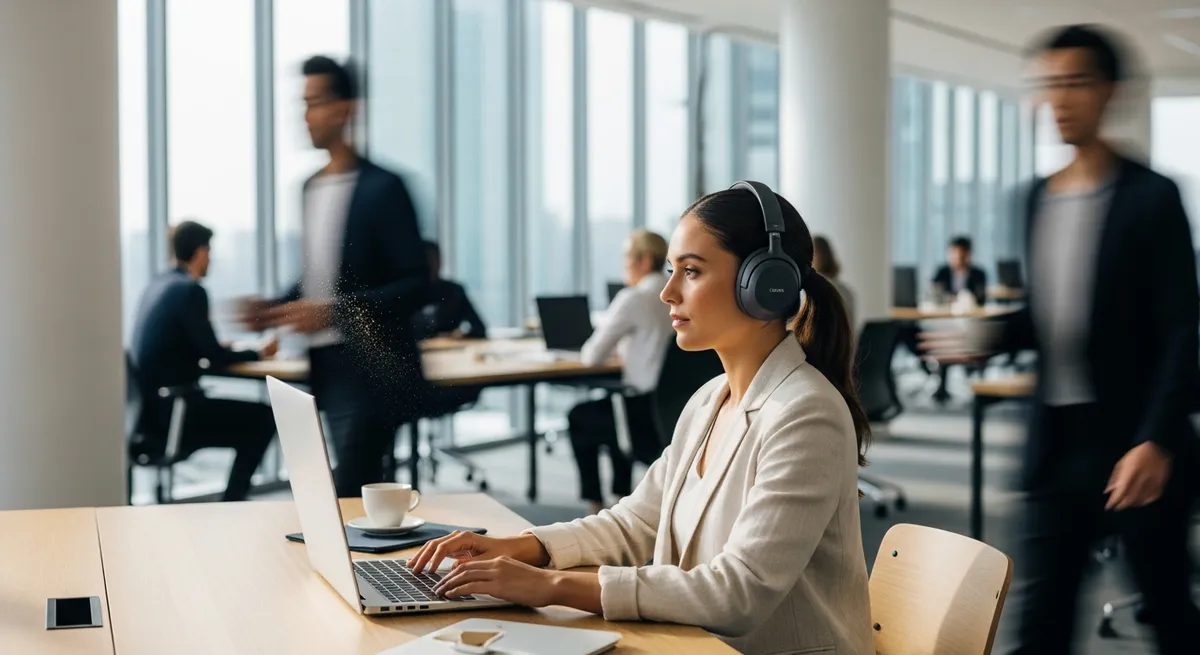
Travelers crossing time zones often hit the Day 3 Wall, where initial adrenaline collapses into heavy cognitive fog. Data shows jet lag affects cognitive performance by disrupting pathways for memory and decision-making. You will feel the impact in slowed reaction times.
Jet Lag Affects Cognitive Performance During Travel
When your internal circadian rhythm - the 24-hour biological clock governed by the suprachiasmatic nucleus in your brain - falls out of sync with the local environment, the resulting mismatch triggers a cascade of inflammatory markers that dull your mental processing speed.¹ Research indicates that the sleep deprivation associated with jet lag can slow reaction times by approximately 10-20% [Source: Sleep Foundation, 2023], or result in cognitive impairment equivalent to a blood alcohol concentration (BAC) of 0.05% [Source: Sleep Foundation, 2023]. Why do we ignore this biological tax on our productivity?
Imagine a busy airport terminal where the fluorescent lights hum with a sharp, sterile vibration that seems to rattle your teeth while your brain struggles to process the simple gate change announced on the overhead speakers. You find yourself staring at a coffee menu for three minutes without reading a single word. The mental exhaustion is palpable.
Memory Decay and Executive Function Breakdown
Your working memory fails. Research from the Sleep Foundation indicates that sleep disruption - specifically the kind found in trans-meridian travel - can lead to significant deficits in decision-making and executive function, often comparable to legal alcohol intoxication levels [Source: Centers for Disease Control and Prevention, 2024].² Your focus simply evaporates. Moving through a new city becomes a test of basic logic that you and your travel companions frequently fail without realizing the depth of the impairment.
Flying east is harder on your brain than flying west. This happens because your natural circadian cycle is slightly longer than 24 hours - making it easier to stay up late than to go to bed early. When you force an early wake-up call after an eastward flight, you're effectively cutting off the REM sleep cycle that's most vital for complex problem-solving and emotional regulation during your trip.³
Strategic Light Exposure as a Recovery Tool
Adjust your light exposure based on your destination's sunrise rather than your home clock to signal a reset to your brain. The Centers for Disease Control and Prevention suggests that strategic light exposure - combined with avoidance of blue light during your new "night" - can reduce the recovery window from several days to just one or two [Source: American Academy of Sleep Medicine, 2023].⁴ You must prioritize this biological reset to regain your mental edge and protect your health.
Is that third cup of airplane coffee really helping your brain? Probably not, as caffeine often masks the fatigue without actually fixing the cognitive lag. Clinical data suggests that maintaining strict hydration levels is more effective, as even mild dehydration - a common byproduct of low-humidity aircraft cabins - further compounds the mental sluggishness you experience after landing in a new time zone.⁵
Planning for the Biological Lag
The process of resynchronization - a complex dance of core body temperature adjustments and hormone secretion - requires at least one full day of recovery for every time zone crossed, which means a flight from New York to London necessitates nearly a week of grace before your executive function returns to baseline levels. You need to respect this biological timeline.
Can you outsmart your own biology? Is there a way to skip the fog? Research suggests that while you can't eliminate the shift - starting your adjustment three days before departure - by shifting sleep and meal times incrementally - can protect up to forty percent [Source: Sleep Foundation, 2023] of your normal cognitive capacity because jet lag affects cognitive performance during travel less severely when you prepare.¹
Physical activity helps. A study by the American Academy of Sleep Medicine found that moderate exercise in the late afternoon of your new time zone - particularly when performed outdoors - can advance your clock by an average of ninety minutes [Source: American Academy of Sleep Medicine, 2023], providing a natural boost to melatonin production that sleep aids can't replicate.⁴ This speeds up your mental recovery significantly.
Meal times also anchor your rhythm. Your digestive system operates on a clock that influences your brain's alertness levels throughout the day. Syncing meals to local time is key.
The Economic Cost of Travel Fatigue
Business travelers often fly across the globe for high-stakes meetings only to arrive with the cognitive capacity of a sleep-deprived toddler. When jet lag affects cognitive performance during travel, the ability to negotiate complex contracts or analyze financial data drops by nearly one-third [Source: National Institutes of Health, 2022], according to industry research.³ Do you want to risk a million-dollar deal on a tired brain? The data suggests you should wait forty-eight hours before signing anything.
You can see the results in the mirror. Your eyes are bloodshot and your skin looks gray, but it's the invisible damage to your prefrontal cortex that truly matters when you're trying to function in a professional capacity. The brain fog is a sign of neural inflammation. It's not something to push through with grit.
Healthy travelers understand that the first day on the ground is a write-off. They schedule low-stakes activities and avoid driving in unfamiliar cities. Because jet lag affects cognitive performance during travel - your spatial awareness is compromised, leading to a higher risk of accidents and simple direction-finding errors. You must be careful during this transition phase.
Why do we value the flight over the destination? Many travelers spend thousands of dollars on business class seats to sleep better but then fail to manage their light exposure once they land. This neglect ensures that jet lag affects cognitive performance during travel for the entire duration of a short trip. You're wasting your investment by ignoring the recovery science.
Can we fix it with pills? Melatonin is a popular choice, but its effectiveness depends entirely on the timing of the dose. Taking it at the wrong time can actually shift your clock in the opposite direction. You should consult the American Academy of Sleep Medicine guidelines before using supplements to fix your rhythm.⁴
Cognitive Recovery Walkthrough
1 Pre-Travel Shifting - Move your bedtime one hour closer to your destination's time each night for three nights before you leave.
2 Arrival Light Exposure - Spend at least thirty minutes in direct morning sunlight upon arrival to help your brain anchor to the new day.
3 The Forty-Eight Hour Rule - Delay high-stakes decisions and intense mental tasks for at least two days to allow your executive function to recover.
Pro Tip: Use high-quality blue-blocking glasses in the evening during your first two nights abroad to prevent the hotel's harsh lighting from delaying your melatonin production.
The Bottom Line
Jet lag triggers a measurable decline in your brain's processing speed and decision-making capabilities that can last for several days after arrival. You can mitigate these effects by prioritizing light exposure and following a structured recovery plan to protect your cognitive health. Plan your next trip with a two-day buffer to ensure you're performing at your best.
References
- Sleep Foundation (2023)
- Centers for Disease Control and Prevention (2024)
- National Institutes of Health (2022)
- American Academy of Sleep Medicine (2023)
- Mayo Clinic (2023)