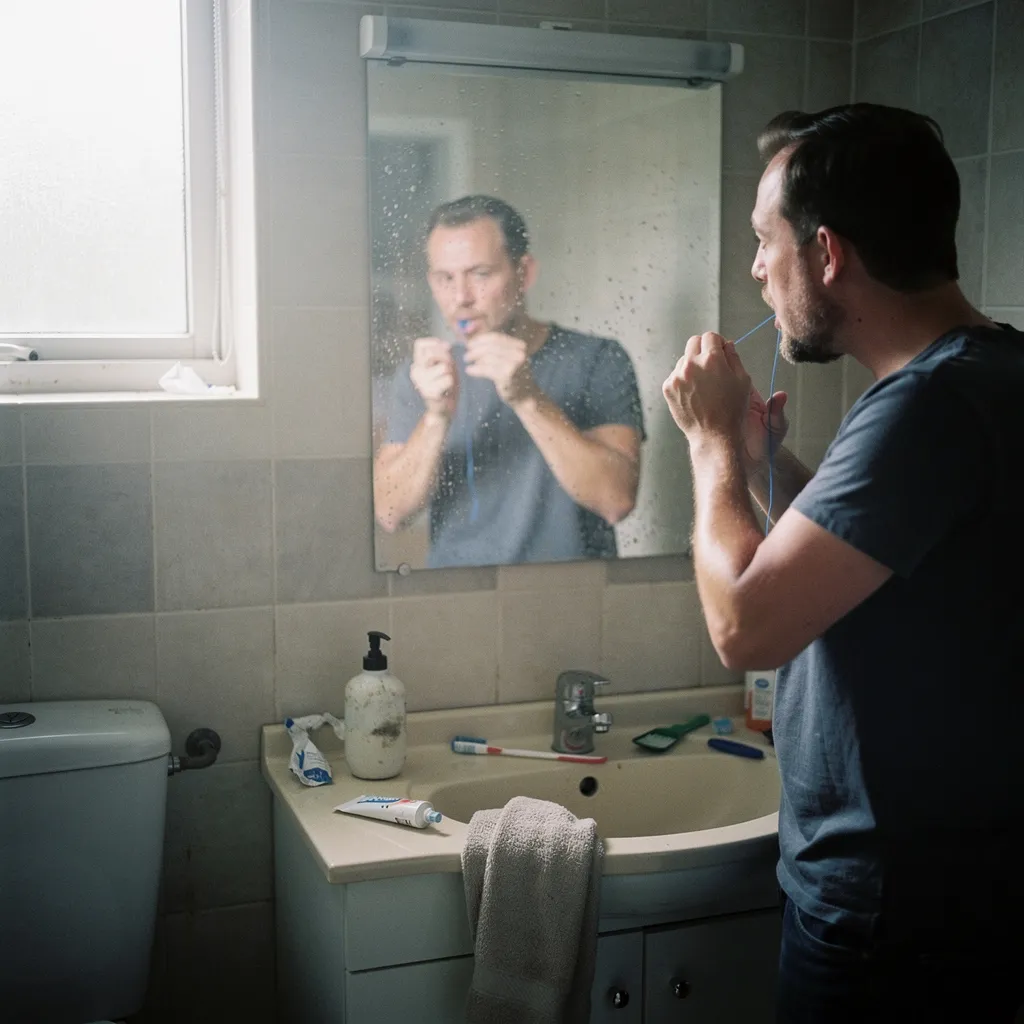
Many people assume they're doing enough for their teeth. They brush once a day, skip floss most nights, and figure that no pain means no problem. The evidence says otherwise, and the gap between common practice and what actually prevents disease is wider than most expect.
The Belief That Dental Hygiene Habits Supporting Long Term Oral Health Are Mostly About Appearance
The most common assumption is that brushing is primarily cosmetic - it keeps teeth white, breath fresh - and that's roughly the end of it. Cavities are seen as a childhood problem. Gum disease is something that happens to other people, usually older ones, usually because of some obvious neglect.
According to the CDC, more than 80% of people will have had at least one cavity by age 345. That figure covers adults who brush. It covers adults who consider themselves to be doing the basics. The plain implication is that "doing the basics" as most people define them isn't sufficient to prevent the most common infectious disease in humans.
Periodontal disease compounds the picture further. Gum disease doesn't just affect the gums. Chronic periodontal infection has been associated in the clinical literature with systemic conditions including cardiovascular disease and diabetes - though the causal direction of those associations remains a subject of ongoing research, and patients should discuss their individual risk profile with a qualified clinician.
Why This Misunderstanding Persists
Dental disease is largely painless until it's advanced. A small interproximal cavity produces no symptom. Gingivitis progresses to periodontitis without an obvious signal. The absence of pain is consistently mistaken for the absence of disease - which is an error that dentists correct in their patients repeatedly throughout a career.
According to the CDC, more than 40% of adults report having felt pain in their mouth within the last year5. That means a large share of adults - those who didn't report pain - may be quietly harboring disease they're unaware of. Pain is a late marker, not an early one.
There's also a tendency to overestimate the effectiveness of a hurried routine. A thirty-second brush covers far less surface area than a two-minute brush. The difference matters mechanically: dental plaque is a structured biofilm, and disrupting it requires sustained mechanical contact with each tooth surface, not a quick pass.
What the Evidence Actually Supports
The CDC recommends brushing teeth well twice a day and flossing between teeth to remove dental plaque.5 Both parts of that sentence matter. "Well" implies technique and duration. "Floss between teeth" addresses surfaces that a toothbrush can't reach regardless of bristle design.
The American Dental Association specifies brushing for two minutes - twice daily, with a fluoride toothpaste. The two-minute mark isn't arbitrary. Clinical timing studies have shown that most people stop at around 45 seconds when left to their own judgment, leaving significant plaque accumulation on posterior and interproximal surfaces untouched.
Fluoride is the other non-negotiable. It remineralizes early enamel lesions and inhibits the metabolic activity of cariogenic bacteria. Fluoride-free toothpaste doesn't provide this protection. The American Academy of Pediatric Dentistry and the ADA both recommend fluoride toothpaste as a standard of care from the time the first tooth erupts.
Diet matters in a direct, mechanical way. The CDC advises avoiding foods and drinks with added sugar as much as possible to maintain a healthy mouth and strong teeth.5 The mechanism is straightforward: Streptococcus mutans and other cariogenic organisms ferment dietary sugars and produce acid as a byproduct. That acid demineralizes enamel. Frequency of sugar exposure matters as much as total quantity - sipping a sugary drink over two hours produces more acid challenge than drinking the same amount quickly.
To put that in concrete terms: a person who drinks one can of sweetened soda in ten minutes gives their enamel roughly one acid exposure event. A person who nurses the same can over a two-hour work meeting gives their enamel a near-continuous acid challenge across that window. Same volume, meaningfully different caries risk.
The Part Most People Underestimate: Professional Care and Biofilm Dynamics
Home care has a hard ceiling. Even a technically correct home routine doesn't remove calculus - mineralized plaque - once it has formed. Calculus harbors bacteria and creates surface roughness that accelerates further plaque accumulation. Its removal requires professional instrumentation. This isn't a commercial argument for dentistry; it's a mechanical fact about the nature of the deposit.
The American Academy of Periodontology notes that gingivitis - the reversible - early stage of gum disease - is directly caused by plaque accumulation at the gumline and can be reversed with professional cleaning combined with improved home care. Once it has progressed to periodontitis, the tissue destruction isn't reversible; it can only be managed. The difference between those two outcomes is often a matter of months, not years, and often involves no pain signal in the interim.
A side-by-side comparison makes this concrete. A patient with gingivitis who begins twice-daily brushing, daily flossing - and attends a professional cleaning can return to healthy tissue. A patient who reaches the same appointment with established periodontitis involving 5mm pocketing and bone loss will require scaling and root planing - a more invasive and more costly procedure - and won't recover the lost attachment. Same complaint, different stage, different clinical trajectory and different cost of care.
Professional recall intervals should be individualized. The standard recommendation of every six months is a population-level guideline, not a fixed biological law. High-risk patients - those with a history of caries, dry mouth from medications - systemic conditions affecting immunity, or active periodontal disease - may require more frequent intervals. Clinicians should determine the appropriate recall schedule based on individual risk factors, not a one-size interval.
The Honest Bottom Line on Preventive Habits
The honest summary is this: the habits that reliably prevent dental disease are well-established, not complicated, and consistently underperformed. Brushing twice daily with fluoride toothpaste for two minutes per session - flossing or using an interdental cleaner once daily, limiting dietary sugar frequency, and attending professional cleanings at a clinician-determined interval constitute the evidence-based standard. None of these recommendations are recent or disputed.
What's also honest is that adherence is genuinely difficult to sustain. Flossing compliance is low across most populations. Evening brushing is skipped more often than morning brushing. The routines that most benefit long-term oral health are the ones done when tired or rushed. Acknowledging that difficulty is more useful than pretending the habits are easy - because patients who understand why each step matters are more likely to maintain them than patients who are simply told to do them.
There's no supplement, rinse, or device that substitutes for the mechanical disruption of plaque through brushing and interdental cleaning. Mouthwash is an adjunct - not a replacement. Oil pulling has no credible evidence base for caries or periodontal prevention. These should be stated plainly, because patients are exposed to marketing that implies otherwise.
What Trips People Up
First mistake: brushing immediately after eating acidic food or drink. Enamel is temporarily softened by acid. Brushing within thirty minutes of an acid challenge abrades softened enamel. The correct timing is to wait at least thirty minutes, or to rinse with water immediately after eating and brush later.
Second mistake: treating bleeding gums as a reason not to floss. Gums bleed when they're inflamed. They're inflamed because of plaque accumulation at the gumline. Stopping flossing in response to bleeding removes the only mechanism that will reduce the inflammation. Consistent daily flossing typically resolves bleeding gums within one to two weeks in the absence of other pathology.
Third mistake: assuming electric toothbrushes are equivalent to manual ones regardless of technique. A correctly used manual brush achieves acceptable plaque removal. An electric toothbrush does reduce technique-dependence and tends to produce better outcomes in patients with limited dexterity or inconsistent manual technique - but an electric brush used for thirty seconds isn't superior to a manual brush used correctly for two minutes. Duration still matters regardless of brush type.
Fourth mistake: believing that adult teeth are stable and therefore lower risk than childhood teeth. The caries risk that produces cavities in children doesn't disappear in adults. Gum recession - which is common in adults - exposes root surfaces that are softer than enamel and more vulnerable to decay. According to the CDC, more than 80% of people will have had at least one cavity by age 34,5 a figure that encompasses the adult years - not just childhood. Oral disease is a lifelong risk, not a phase that adults age out of.
This article is general health information only and doesn't constitute clinical advice. Individual oral health status, disease risk, and appropriate care intervals vary significantly. Consult a licensed dentist or periodontist to assess your own situation and receive guidance specific to your clinical needs. Figures cited are approximate and subject to change.
References5 Centers for Disease Control and Prevention (CDC). Oral Health. cdc.gov.
References
- https://dentistry.uic.edu/news-stories/the-many-costs-financial-and-well-being-of-poor-oral-health/
- https://www.who.int/news-room/fact-sheets/detail/oral-health
- https://my.clevelandclinic.org/health/treatments/16914-oral-hygiene
- https://www.cdc.gov/oral-health-data-systems/about_oral_health_data/index.html
- https://www.cdc.gov/oral-health/prevention/oral-health-tips-for-adults.html
- https://pmc.ncbi.nlm.nih.gov/articles/PMC8860786/
Disclaimer
This article is for general informational purposes only and isn't medical or health advice, nor a substitute for professional care. For your own health - talk to your doctor or a qualified provider.