The teak was the color of a good saddle and it creaked once when his full weight settled. A paper tag swung from the left armrest on a white string and he caught it without looking, the way you catch a door before it slams. Fourteen hundred and ninety-nine dollars, and below that in letters so small he had to pull the tag closer: *Reclaimed Indonesian Hardwood. * He read that twice, then let the tag drop, and sat there with his pulled hamstring stretched out in front of him and his tape measure pressing into his hip - looking out past the showroom doors at the parking lot.
He photographed the sectional from three angles, the phone held above his head like he was wading somewhere, and his elbow knocked a throw pillow onto the showroom floor. The egg chair caught the ceiling vent and spun a quarter-turn while his wife's hand was still on it, and he got that one blurry. The teenager crouched at the base of the fire pit table and pressed something with a pen cap and the glass beads bloomed orange from underneath, and Dale held his phone closer - closer, until his own face appeared in the dark screen between flames.
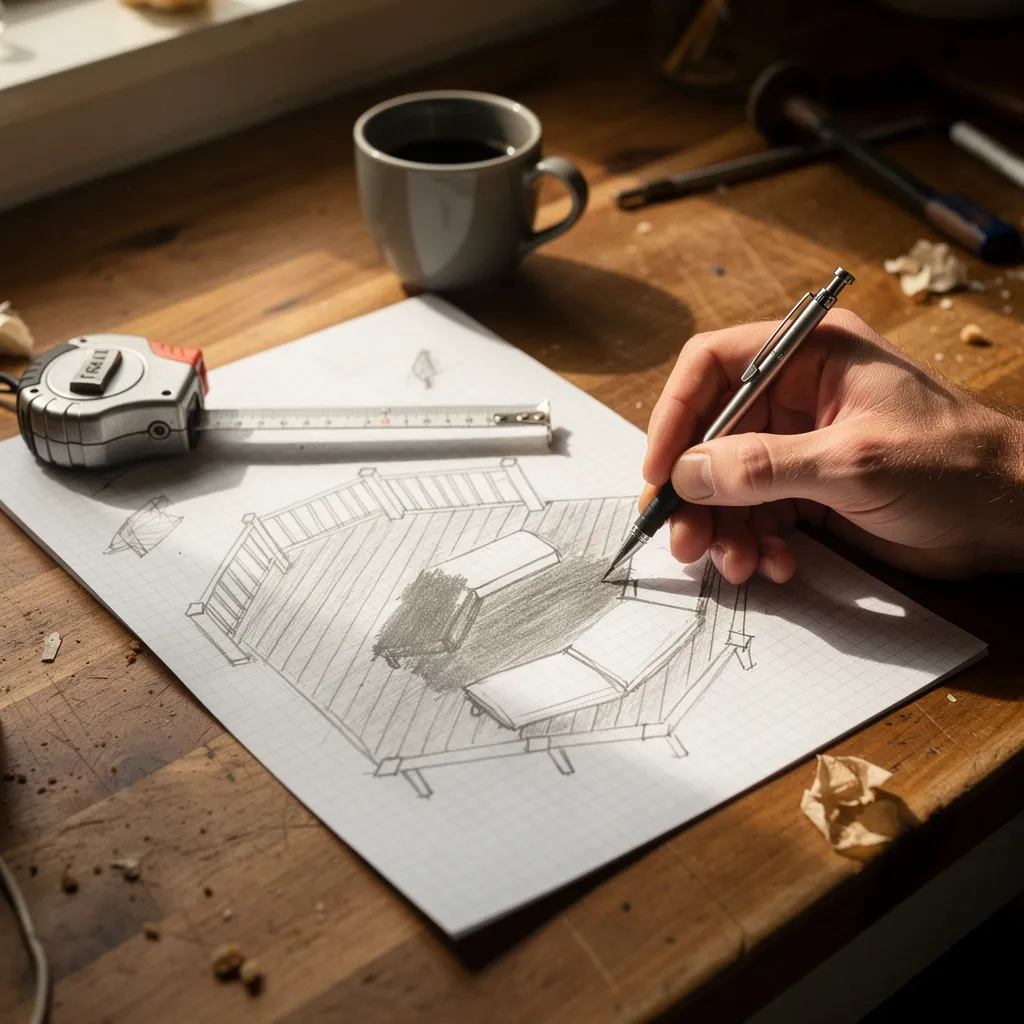
The graph paper was a quarter-inch grid and he'd bought it specifically, a fresh pad from the office supply store, but by the second hour there was a gray smear where the sectional kept going and the paper had thinned to something almost translucent. He moved the grill three times in pencil, each ghost square still faintly visible underneath the new one. The dogwood was fourteen feet from the fence - he'd measured it twice with the same tape that had pressed into his hip all afternoon - and he sat with that number written in the margin - circled, the mechanical pencil clicking in and out in his hand without him seeming to notice.
The truck had DALE printed on a yellow square of paper taped to the dashboard, and one of the men peeled it off and tucked it into his shirt pocket as he climbed down. They set the crate on the flagstone with a sound like a dropped dictionary and the taller one produced a flathead screwdriver and popped the slats loose, and the teak came out wrapped in brown paper that Dale didn't throw away immediately. The tablet screen showed $1,340. 00 and below it a line for signature and below that - in gray, the running total with the side table and the throw pillows and the cover kit: $3,912.
The cushion was still in the plastic sleeve, and the plastic had gone milky where the sun hit it, and one corner had started to peel up and then stopped. A dogwood leaf sat in the chair's seat - cupped like a small brown hand, and it had been there long enough to leave a faint wet outline on the teak beneath it. Dale ate his chicken and rice at the kitchen table, standing at the counter actually, one hand on the edge, watching the six-thirty weather through the pass-through window - the patio furniture going dark out there as the light went. The graph paper pad was on the counter too, under his keys, the top sheet with the grill ghosts still facing up.
The tape measure was yellow Stanley, the case cracked along the seam where he'd dropped it on the garage floor sometime before all this, and the belt clip had left a rust-colored shadow on the denim like a small door. He set it on the counter next to his keys and a Walgreens receipt and the mechanical pencil - which still had the graph paper's gray smear on its barrel. Through the window the teak chairs sat under the cover kit, two dark humps in the October light, the cover's zipper pull swinging once in something that wasn't quite wind. He left the tape measure there and got his coffee and went to stand somewhere else.
The catalog came in the spring, glossy, a woman laughing on the cover with her feet up on a teak ottoman - a glass of something sweating in her hand, and Dale set it on the kitchen table and went to get his reading glasses from the nightstand. He came back and sat down and opened it to a folded corner someone had already made, though he lived alone now, and the page showed a dining set, six chairs - expandable table, the wood the same color as his, and the price in a small font at the bottom that he had to bring the glasses down from his hair to read. He looked at it for a moment, then looked through the pass-through window at the two covered humps, then back at the page - his thumb leaving a small damp print at the corner. He didn't dog-ear it and he didn't close it.
He unzipped the cover on a Saturday in April and the left chair had gone gray along the armrest where the teak had dried out, a pale stripe the width of three fingers, and he ran his thumb across it the way you test a bruise. The can of teak oil was on the garage shelf behind the ice melt, and it was still sealed, the price sticker from the hardware store still on the lid: $18. 99. He brought it out and set it on the flagstone next to the chair and went back inside to find a rag - and found one, and came back out and stood there with the rag in his hand looking at the pale stripe, the sun on the yard, the catalog still on the kitchen table where he'd left it open.
He opened the can and the oil was darker than he expected, almost amber - and he dipped the rag and the smell came up sharp and mineral, the kind that stays in your nose for a day. He did the armrest in slow strokes and the gray went away and the teak came back the color it was in the showroom, the color of a good saddle, and he sat back on his heels and looked at it. The other chair had the same pale stripe, he could see that now - and the table too along the near edge, and the can was eight ounces. He set the rag down on the flagstone and looked at the catalog through the pass-through window, still open to the dining set, six chairs, and then back at the can - and did the math without a pencil.
Further reading
- https://www.thisoldhouse.com/home-finances/outdoor-living-trends
- https://duraweather.com/?srsltid=AfmBOoq14m0pC-uKiplUzCViJz0rg9Z-RonlcPQ4HMgkfzTSq8Ij_eLd
- https://www.epconcommunities.com/epcon-insights/lifestyle/importance-of-outdoor-living-space
- https://www.hqts.com/outdoor-furniture-inspection-and-qc-standards/
Disclaimer
This article is a personal reflection shared for general informational purposes only. It is not financial, investment, insurance, or tax advice. For decisions about your own money, please consult a qualified financial professional.